Sea buckthorn has been having a serious skincare moment lately. You will find it in supplements, oils, serums, juices and even moisturisers. But this bright orange berry is not exactly a new discovery.
For centuries, sea buckthorn has been used in traditional Tibetan and other Asian systems of medicine. The fruit itself is unusually nutrient dense, containing vitamins, carotenoids, polyphenols, phytosterols and a distinctive fatty acid profile that includes omega 3, 6, 7 and 9. [NIH]
So, is sea buckthorn good for skin? Potentially, yes. But when it comes to sea buckthorn for skin, the form you choose matters.
What makes sea buckthorn interesting for skin?
1. Vitamin C supports collagen formation
Vitamin C is required for collagen biosynthesis and also functions as an antioxidant. Since collagen is an important structural protein in skin and connective tissue, adequate vitamin C is relevant to normal skin maintenance. [NIH]
2. Carotenoids provide antioxidant activity
The orange colour of sea buckthorn comes partly from carotenoids such as beta carotene and other pigments. These compounds contribute to the fruit's antioxidant capacity. [NIH]
3. Omega 7 makes it particularly interesting
This is where sea buckthorn gets a little different from many other berries.
Its pulp is naturally rich in palmitoleic acid, also known as omega 7. Pulp oil can contain particularly high proportions of this fatty acid, along with carotenoids and other lipid soluble compounds. [NIH]
Research on sea buckthorn preparations has also found effects relevant to skin barrier function, hydration and dryness, although human evidence is still developing. ([NIH])
So, which sea buckthorn form is best for skin?
This is where the distinction between juice, pulp and oil becomes important.
There is no universally "best" form because each concentrates a different part of the berry.
But if your goal is whole fruit nutrition with a broader spectrum of naturally occurring compounds, an unfiltered sea buckthorn pulp can be a particularly interesting choice.
Why?
Because the pulp contains more than the watery fraction of the fruit. Sea buckthorn's lipid soluble compounds, including carotenoids, tocopherols and fatty acids, are associated with the pulp and oil fractions. In one analysis, clarified juice contained very little lipid, tocopherol or carotenoid, while the pulp fractions contained substantially more of these compounds. [NIH]
That does not mean every sea buckthorn pulp automatically contains more nutrients than every juice. Processing makes a major difference. But it does explain why an unfiltered, pulp-based preparation can offer a broader representation of the berry than a clarified juice.

So if you are specifically looking at sea buckthorn skin care from the inside out, an unfiltered pulp gives you an interesting middle ground, rather than focusing exclusively on one isolated fraction.
What should you look for in a sea buckthorn pulp?
Not all sea buckthorn products are made the same way.
A thoughtfully formulated pulp can retain more of the berry's naturally occurring matrix, particularly when it is cold pressed and unfiltered. The processing method matters because filtration, clarification and heat treatment can alter the final phytochemical profile. [NIH]
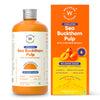
For example, a Himalayan sea buckthorn pulp made from wild harvested berries and processed without unnecessary fillers can provide the fruit's naturally occurring vitamin C, carotenoids, polyphenols, vitamin E and omega fatty acids in one preparation.
Adding complementary compounds can also make nutritional sense. Curcumin, for example, is another plant derived source of polyphenols with antioxidant and inflammation related research behind it. However, its presence does not mean the product should be treated as a treatment for inflammatory or skin conditions.
The more useful way to think about sea buckthorn is simple: it is a nutrient dense fruit, not a skincare miracle.
What are the sea buckthorn skin benefits?
The potential benefits of sea buckthorn for skin largely come from its combination of nutrients rather than one magic ingredient.
It can provide:
-
Vitamin C, which supports normal collagen formation and antioxidant defence. [NIH]
-
Vitamin E and carotenoids, which contribute to antioxidant protection. [NIH]
-
Omega 7 and other fatty acids, which are relevant to skin lipid composition and barrier function. [NIH]
-
Polyphenols and flavonoids, which contribute to the antioxidant activity of the fruit. [NIH]
-
A broad spectrum of phytonutrients, rather than relying on a single isolated compound.
There is also human research specifically investigating sea buckthorn preparations and skin related outcomes. One study found that topical sea buckthorn extract improved skin hydration and reduced transepidermal water loss over 84 days. [NIH]
Another human study found that oral sea buckthorn oil influenced fatty acid composition in plasma and was associated with improvements in atopic dermatitis symptoms in the pulp oil group, although this is not enough evidence to claim that sea buckthorn treats dermatitis. [NIH]
That distinction matters.
Sea buckthorn is promising for skin health, but it is not a substitute for sunscreen, a balanced diet, adequate protein or clinically indicated dermatological treatment.
How to use sea buckthorn for skin
If you are taking sea buckthorn as a nutritional supplement, follow the serving instructions of the specific product.
A pulp based sea buckthorn juice can be incorporated into your daily routine as a concentrated fruit preparation. Because sea buckthorn is naturally very tart and acidic, it is commonly diluted according to the product directions.
And if you are choosing between products, look beyond the word "sea buckthorn" on the front label.

Those details tell you far more about the product than the ingredient name alone.
Key takeaways
-
Sea buckthorn is more than a trendy skincare ingredient, it has a long history of traditional use and a naturally diverse nutritional profile.
-
Its vitamin C, vitamin E, carotenoids, polyphenols and fatty acids make it particularly interesting for skin nutrition.
-
Pulp and juice are not nutritionally identical. Clarified juice can lose some lipid associated compounds found in the pulp.
-
Omega 7 is one of sea buckthorn's standout features, particularly in its pulp and pulp oil.
-
For sea buckthorn skin care, look at the whole formulation and processing method, not just the words "sea buckthorn" on the label.
FAQs
1. Is sea buckthorn good for skin?
Sea buckthorn contains vitamin C, vitamin E, carotenoids, polyphenols and fatty acids that are relevant to normal skin structure, antioxidant defence and barrier function. Human research on specific sea buckthorn preparations is promising but still limited. [NIH]
2. Which sea buckthorn is best for skin?
For a broad nutritional profile, an unfiltered sea buckthorn pulp can be a useful option because it can retain both water soluble and lipid associated components of the fruit.
3. Is sea buckthorn juice good for skin?
Yes, sea buckthorn juice can provide nutrients such as vitamin C and polyphenols. However, clarified juice may contain less of the lipid associated compounds found in the pulp. [NIH]
4. Is sea buckthorn pulp better than juice?
Not necessarily in every situation. Pulp can retain more fruit solids and lipid associated compounds, while juice can retain substantial amounts of vitamin C. The processing method ultimately determines the nutritional profile.
5. What is omega 7 in sea buckthorn?
Omega 7 refers primarily to palmitoleic acid. Sea buckthorn pulp and pulp oil are notable natural sources of this fatty acid. [NIH]
6. Does sea buckthorn contain vitamin C?
Yes. Sea buckthorn is naturally rich in vitamin C, although the amount varies considerably between varieties and growing conditions.
7. How do you use sea buckthorn for skin?
For nutritional use, sea buckthorn pulp or juice can be consumed according to the product's recommended serving. Topical sea buckthorn preparations are another option, but they are different from oral supplements.
8. Does sea buckthorn have antioxidants?
Yes. Sea buckthorn contains vitamin C, vitamin E, carotenoids, flavonoids and other polyphenolic compounds that contribute to antioxidant activity.